EDITORIAL: Failed launch of H-3 rocket casts doubt on Japan’s space program
 Asahi Weekly 紙面のお申し込みはこちら
Asahi Weekly DIGITALのダブルコースは、事前に紙面の購読申し込みが必要です。こちらのページからAsahi Weeklyの紙面購読申し込みをおこなってください。

英訳社説
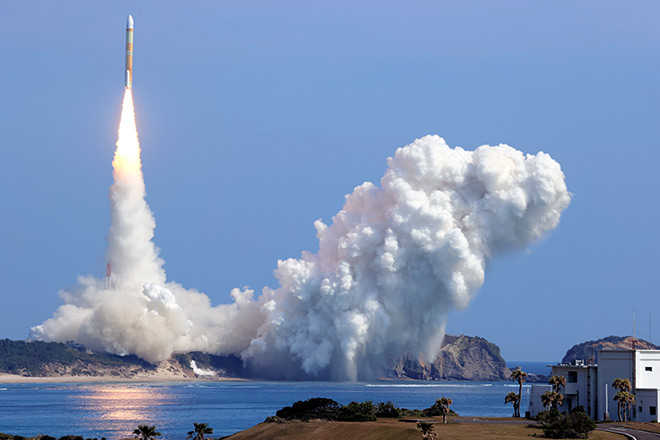
Japan’s first H-3 rocket lifts off from the Tanegashima Space Center in Kagoshima Prefecture on March 7. But the launch ended in failure as the second-stage engine did not ignite. (Minako Yoshimoto)
The inaugural launch of Japan’s domestically produced H-3 rocket, developed by the Japan Aerospace Exploration Agency (JAXA) and Mitsubishi Heavy Industries Ltd., ended in failure on March 7.
The second-stage engine failed to ignite and JAXA was forced to send a self-destruct signal. An Earth-observation satellite loaded on the rocket was also destroyed.
The successor of the H-2A currently in operation, the H-3 is positioned as Japan's flagship rocket.
It is expected to fulfill many functions over the 20 years from fiscal 2023, such as providing supplies to the International Space Station and launching a probe for a Martian moon.
In view of past failed launches, there is no denying the possibility that it could be more than a year before the rocket is ready for the next launch.
The consequences of the H-3 remaining idle for the time being will be far-reaching. We must say this is a grave situation for Japan's space development program.
JAXA and the science and technology ministry are trying to determine why the launch failed.
In the future, the H-3 is meant to enter an international market for satellite launching. If its reliability is to be restored, JAXA and the ministry must conduct objective investigations and fulfill their accountability.
JAXA failed to launch its small Epsilon rocket in October. Causes of the failure are being examined, but there is no prospect of another launch, which raises questions about JAXA’s credibility.
When development of the H-3 began in 2014, JAXA’s aim was to launch it in fiscal 2020. But problems were found in the new main engine, and the launch schedule continued being postponed.
On Feb. 17, an abnormality was discovered after the main engine was ignited, and the liftoff had to be canceled at the last minute.
JAXA said it had identified the cause of the problem and had come up with measures to prevent a recurrence in two weeks. But we wonder if the agency rushed things to avert any further delay.
The H-2A, which failed to launch in 2003, has since proven itself to be highly reliable and stable through 40 consecutive successful launches.
But it has received only limited orders for satellite launches and lacked international competitiveness because of its high cost, said to be 10 billion yen ($72.8 million) per launch.
For that reason, the H-3 was developed with the aim of cutting the cost by half. The number of parts and components has been reduced, and those developed for consumer applications, such as in automobiles, have been used.
We also understand that the developers are reducing the number of personnel involved in launches and also raising the efficiency of production lines.
The global space industry is expected to keep expanding and so will demand for rockets.
There are many formidable competitors abroad, such as SpaceX, which has already achieved considerable cost-cutting and has launched an overwhelming number of rockets.
With the H-3, could it be that the simultaneous pursuit of high performance and low cost rendered the development program somewhat unrealistic?
This also raises questions about joint development and task-sharing between JAXA and private companies.
To move forward by learning from the failed launch, we hope JAXA and others involved will continue to re-examine the process with an open mind.
--The Asahi Shimbun, March 8
宇宙航空研究開発機構(JAXA)と三菱重工業が共同開発した国産ロケット「H3」の初号機の打ち上げが失敗に終わった。第2段エンジンに点火しなかったため、信号を送って意図的に破壊した。搭載していた地球観測衛星も失われた。
H3は、現在運用中のH2Aの後継機で、日本の「基幹ロケット」と位置付けられる。来年度以降、国際宇宙ステーションへの物資補給や火星の衛星への探査機打ち上げなど今後20年間、多くの役割を担う予定だ。
過去の打ち上げ失敗例をみても再開まで年単位の時間がかかる恐れも否定できない。H3が当面運用できないとなれば影響は多方面に及ぶ。日本の宇宙開発にとって深刻な事態である。
JAXAや文部科学省が原因解明に乗り出している。H3は将来的には国際的な衛星打ち上げ市場に参入することを目標にしている。調査に客観性を持たせ、説明責任を果たしていくことが信頼回復に欠かせない。
JAXAは昨年10月、小型ロケット「イプシロン」の打ち上げに失敗したばかりだ。原因究明が進むが、打ち上げ再開のめどは立っていない。組織としての信用も問われる。
14年に開発が始まったH3は当初、20年度の打ち上げを目指していたが、新しい主エンジンに課題が見つかり、延期を重ねてきた。
先月17日にあった打ち上げでは、主エンジン点火後に異常が検知され、直前で中止になるトラブルも起きた。2週間で原因究明と再発防止策を終えたというが、これ以上遅らせることはできないという焦りのようなものがなかったのか。
現行のH2Aは、03年の失敗以降は40回連続で打ち上げを成功させるなど高い信頼性と安定性を実現した。一方、1回100億円とも言われるコストのため、衛星打ち上げの受注は限られ、国際的な競争力の点では不十分だった。
そのためH3は費用の半減を目標に開発がなされ、部品の総数を減らし、自動車など民生用の採用などが図られてきた。打ち上げ作業にかかる人員を減らし、生産ラインの効率化も進められているとも聞く。
世界の宇宙産業は拡大していくと予想され、ロケットの需要も高まると見込まれる。海外では既に低価格を実現して圧倒的な打ち上げ回数を誇るスペースXなど競合相手も多い。
H3は高い性能とコスト削減を同時に追い求め、計画そのものに無理が生じていなかったか。企業との共同開発や役割分担も問われるところだ。失敗を糧に前に進むためにも幅広い視野から検証を重ねてほしい。
(2023年3月8日)
 紙面購読者の方はこちら!
※朝日IDにログインしてからのお申し込みになります。朝日ID会員でない方は新規会員登録(無料)にお進みください。
※ダブルコースの方は朝日ウイークリーデジタル(300円)が初回1カ月間無料になります。紙面(1600円)については初月より通常料金です。
Asahi Weekly DIGITALのダブルコースは、事前に紙面の購読申し込みが必要です。こちらのページからAsahi Weeklyの紙面購読申し込みをおこなってください。